At Just Eight, Kartavya Rana Is Taking Indian Theatre to a New Generation Through Mono-Acting
With 55 live mono-acting performances and recognition from India Book of Records, the young performer is emerging as a promising face of Indian theatre, art, culture, and the performing arts.
Anand, Gujarat: At an age when most children are only beginning to discover their interests and abilities, eight-year-old Kartavya Vaibhavkumar Rana is already developing a distinctive identity in the Indian performing arts—an identity built around theatre, character acting, and the creative presentation of India’s cultural narratives.
This young theatre performer from Gujarat has built an unusual artistic journey not merely because of his age, but because of the seriousness, discipline, and consistency with which he has approached theatre and the demanding form of mono-acting (Bhāṇa) from an exceptionally early age.
A Young Performer Embracing the Challenge of Mono-Acting
Mono-acting is among the most demanding forms of theatre because the entire performance rests on a single performer. There is no co-actor with whom the dialogue, emotion, or stage energy can be shared. The performer must bring the character and narrative to life through voice, expression, physical movement, memory, emotional communication, and stage presence.
Kartavya has embraced this challenge at an age when most children are still developing their basic understanding of performance.
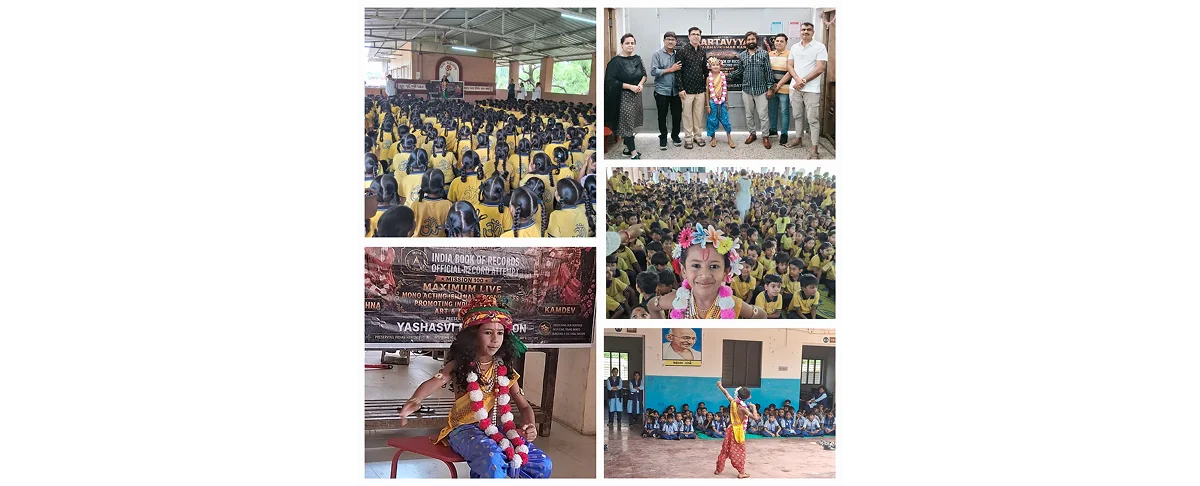
His theatrical repertoire includes characters such as Bharata Muni, Ashwatthama, Yuyutsu, Shakuni, Kartikeya, Abhimanyu, Lord Krishna, and Kamdev. Through these roles, he has explored different voices, emotions, physical expressions, and character personalities.
His performances have been witnessed and appreciated by more than 35,000 students, teachers, and audience members.
An Acting Journey That Began in Infancy
Kartavya’s connection with acting began at an exceptionally early age.
In 2018, at approximately six months of age, he appeared in the English short drama “Parashuram,” presented by Yashasvi Foundation, Nadiad. He portrayed infant Lord Shri Ram in a dramatic sequence in which Lord Parashuram comes to bless Lord Shri Ram following his birth.
At that time, Kartavya had no formal understanding of acting. Yet that brief appearance became the beginning of a continuing journey in theatre and the performing arts.
His work subsequently expanded beyond theatre into films, short films, music videos, and advertising films, giving him opportunities to explore different forms of screen performance.
From Theatre to the Screen
Kartavya has appeared in a number of screen projects and music videos at different stages of his childhood.
Among them is “Amba Ghoome Lai Bahuchar No Saath,” in which he performed alongside Gujarati artist Nishan Pandya, who has also been associated with the popular song Ganpati Aayo Bapa Riddhi Siddhi Layo.
He also appeared in the music video “Gurjari Na Mahida,” alongside well-known Gujarati and Rajasthan-associated actress Sharmistha Makwana. In the video, Sharmistha Makwana portrayed Kartavya’s mother.
In addition, the music video “Kana Re” featured Kartavya portraying young Lord Krishna, with his character appearing throughout the song.
Despite these screen appearances, theatre remains the foundation of Kartavya’s artistic identity.
Recognition Beyond a Record
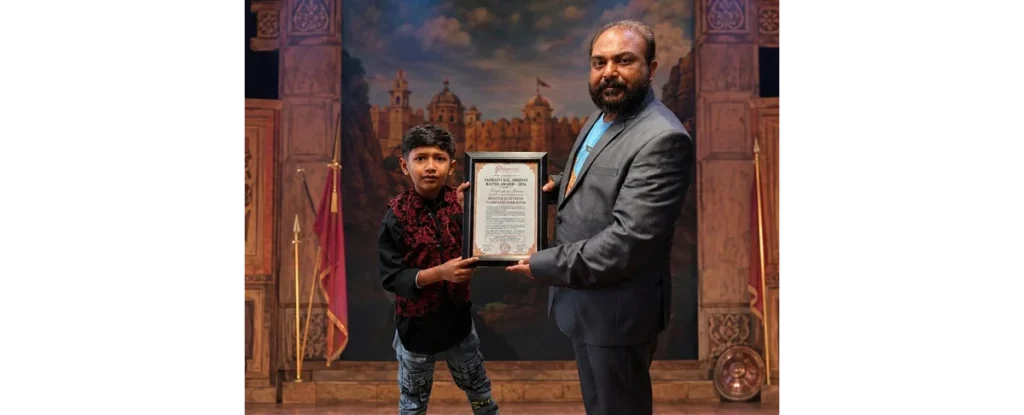
Kartavya’s acting journey has received recognition through several awards and honors, including the Yashasvi Bal Abhinay Ratna Award–2026, Mission 50+ Excellence Award, World Theatre Day Award, Child Theatre Actor Award, as well as Best Child Actor Awards associated with Sundarvan and Parashuram.
He has also received recognition for acting training and participation in various cultural and theatrical initiatives.
What makes these achievements particularly notable is that Kartavya continues to pursue his education alongside his artistic activities. Despite his performance commitments, he continues to maintain strong academic performance at school.
A Child Artist Recognized by Senior Professionals
Kartavya’s growing artistic journey has received appreciation from senior personalities associated with Indian theatre, cinema, literature, and the performing arts.
His name has been submitted for the Pradhan Mantri Rashtriya Bal Puraskar – 2026 in the Art & Culture (Theatre) category. His artistic journey has received recommendations and letters of appreciation from respected personalities associated with theatre, cinema, and academia.
These include Padma Shri Jagdish Trivedi, Pan Indian Cinema senior actor Akhilendra Mishra, and National Film Award Best, Feature Film Winner Director Abhishek Shah (Hellaro) and Senior Academic and Theatre Personality Dr. Mahesh Champaklal Shah. (M.S. University Former Dean & HOD Faculty Of Performing Arts), Dr. Navneet Chauhan, former Professor and Head of the Department of Hindi at Sardar Patel University, has also supported Kartavya, particularly recognizing his engagement with theatre and Indian theatrical traditions.
The significance of these recommendations lies not simply in the names attached to them, but in what they recognize: a young performer who is approaching acting not merely as an opportunity, but as a continuing discipline of practice, learning, and artistic development.
Theatre Remains at the Heart of Kartavya’s Artistic Identity
For Kartavya, theatre remains the foundation of his journey.
His performances demonstrate how Indian mythology, stories, characters, and cultural traditions can be presented to a new generation through the work of a young performer. His mono-acting brings together acting, storytelling, Indian culture, language, physical expression, and traditional narratives.
At only eight years of age, Kartavya’s achievement of 55 live mono-acting performances is not an endpoint, but an important early milestone in what may become a much longer journey in Indian theatre and cinema.
As his journey continues, his focus remains on learning, training, and bringing new characters to life on stage—while keeping Indian theatre, art, and culture at the heart of his work.
Kartavya Rana may be only eight years old, but his theatrical journey raises a much larger question: How early can a child begin carrying the responsibility of an entire theatrical performance—and transform that responsibility into a meaningful celebration of Indian culture?
About The Author