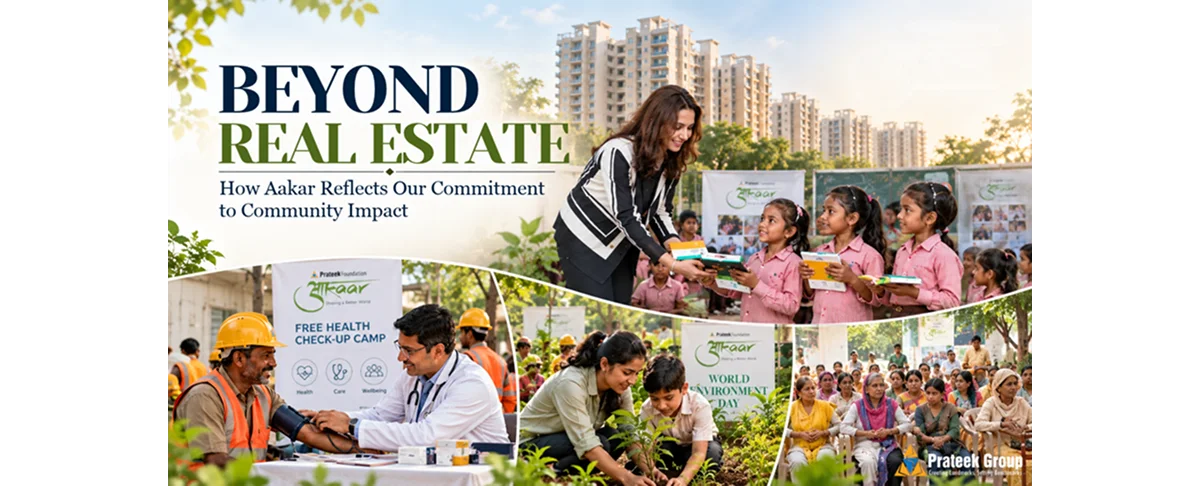
Beyond Real Estate: How Aakar Reflects Our Commitment to Community Impact
Through Aakar, we have tried to extend our idea of development beyond homes and neighbourhoods to education, health, sustainability and community welfare.
When we think of real estate, the first image is usually a physical one: buildings taking shape, neighbourhoods expanding and new addresses appearing on a city map.
But development is never only about what rises from the ground. It is also about the people who build those spaces, the families who eventually live in them and the communities that grow around them.
At Prateek Group, this wider understanding of development finds expression through Prateek Foundation – Aakar.
Over the years, we have used Aakar as a way to stay connected with different parts of the communities around us, whether through education, worker healthcare, environmental awareness, senior citizen care or support during difficult times.
The thought behind it is captured in a simple phrase: “Shaping a Better World.”
For us, that does not mean making large claims. It simply means recognising that the quality of life around the homes we create depends on much more than construction alone.
Starting With Education
Education has remained one of the areas we have continued to engage with through Aakar.
During an Independence Day programme at a government school near Prateek Canary, we distributed stationery to more than 150 students. Members of our team also joined the school’s flag-hoisting ceremony and spent time interacting with the children.
It was a fairly simple initiative, but one built around an everyday requirement.
For many children, access to books, stationery and basic learning material can make a meaningful difference to their experience at school.
Through our Mission Education initiative, we have also supported poor, orphaned, differently abled and underprivileged children associated with the Children Reading Society by providing school bags, books and other educational material.
Our engagement has also extended to less privileged girl children associated with the organisation, with education remaining at the centre of the effort.
At Primary School Garhi Samastipur, a slide swing was also provided for students, adding a recreational element to the school environment.
For us, these initiatives reinforce a fairly simple belief: childhood development is not limited to academics. Access to learning, play and safe spaces all contribute in different ways.
Community development does not always begin with a large intervention. Sometimes, it starts by noticing a practical need and doing what is possible to address it.
Supporting the People Behind the Buildings
The workforce behind every project is closely connected to the spaces we eventually create.
On Labour Day, May 1, 2026, through Aakar, we organised a free health check-up camp at Prateek Grand Begonia in Siddharth Vihar, Ghaziabad. More than 100 workers and labourers participated.
The camp was conducted with Max Healthcare, Clove Dental and Tomfrenk Eyewear and included blood pressure and blood sugar checks, cholesterol screening, eye and dental consultations, pulmonary function testing, BMI assessments and general physician consultations.
There was no fee or prior registration requirement.
The idea was straightforward: make basic preventive healthcare easier to access for the workers on site.
In real estate, it is easy to focus on the final building and forget the number of people involved in bringing it to life.
For us, worker welfare is therefore not separate from the larger idea of responsible growth. It is part of the same ecosystem.
Bringing Sustainability Into Everyday Life
Sustainability is often discussed through large ideas such as energy efficiency, green infrastructure and resource management.
But it also begins with everyday habits.
That thought shaped “Harit Ghar,” a gardening workshop held at Prateek Grand City on World Environment Day in June 2026.
More than 100 residents, including families and children, participated in sessions covering vertical gardening, seasonal plant selection and basic soil care.
Participants were also given starter kits to help them begin or improve balcony gardens at home.
What we liked about the idea was its simplicity.
A balcony garden may seem like a small intervention, but when similar habits become part of a residential community, they can encourage greater awareness around greenery, waste and responsible consumption.
Children become involved. Families learn together. Sustainability becomes something people can practise in their everyday lives.
For us, that is an important part of creating sustainable communities. Environmental responsibility becomes more meaningful when residents have an opportunity to participate rather than simply observe.
When Sustainability Meets Inclusion
On World Earth Day, we collaborated with Sheroes Café in Noida for an initiative titled “Planting for Healing.”
The programme brought members of our team together with acid attack survivors associated with the café for a plantation activity.
Large mobile planters were placed across active spaces within Sheroes cafés and offices so that the plants could continue to be maintained beyond the day of the event.
The women associated with Sheroes Café also participated directly in the activity.
That participation was important.
When we speak about women empowerment, we believe it is also worth thinking about dignity, visibility and the opportunity to participate on equal terms.
Planting for Healing brought environmental awareness and inclusion into the same setting without trying to make one overshadow the other.
For us, it was simply one example of how a community initiative can sometimes connect different concerns in a thoughtful way.
The Value of Simply Showing Up
Not every community initiative has to be centred around healthcare, education or material support.
Sometimes, presence matters.
For Mother’s Day, through Aakar, we spent time with elderly women at SHEOWS Care Centre in Delhi.
The programme included conversations, interactive activities, a cake-cutting ceremony, refreshments and the distribution of sarees and gowns.
These are modest gestures, but companionship has its own importance.
For senior citizens who may experience isolation, being included, listened to and simply having people spend time with them can make a difference.
It also reflects something we see in community living more broadly.
Quality of life is not defined only by physical comfort. Social interaction, emotional well-being and a sense of belonging matter too.
That thought was also reflected in an International Yoga Day activity at Prateek Grand City, where more than 50 residents came together for a guided yoga and wellness session.
It was a simple community activity, but it created another opportunity for residents to meet, participate and spend time together.
For us, empowering communities is not always about doing something for people. Sometimes it is about creating spaces where people can take part themselves.
Being Present During Difficult Times
The role of community support becomes especially visible during periods of crisis.
During the COVID-19 pandemic, Prateek Foundation Aakar organised a vaccination camp in association with Fortis Noida at Prateek Edifice in Sector 107, Noida.
Residents, employees, housekeeping and club staff, allied personnel and workers engaged through third-party organisations were among those covered.
At a time when vaccination access was a major public health priority, the initiative helped extend support across different groups connected to the residential community.
A similar response can be seen further back.
Following the Uttarakhand natural calamity in 2013, we contributed to the Prime Minister’s National Relief Fund to support relief and rebuilding efforts.
For us, these moments reinforce an important aspect of social responsibility.
Not every requirement can be planned in advance. Sometimes it is simply about responding when support is needed.
Looking Beyond the Numbers
Across Aakar’s different initiatives, the numbers give a sense of scale.
More than 150 students were reached through a stationery distribution drive.
More than 100 workers participated in a health camp.
Over 100 residents joined the Harit Ghar environmental workshop.
More than 50 residents participated in a community wellness session.
But we do not see the numbers as the whole story.
Behind them are individual moments: a student receiving learning material, a worker undergoing a preventive health check, a senior citizen spending time in company or a family learning how to grow plants at home.
These are not extraordinary interventions.
And perhaps they do not need to be.
Their relevance lies in addressing everyday needs and creating small opportunities for participation, support and connection.
What Building Beyond Homes Means to Us
A city may be defined visually by buildings, but its character comes from people.
The workers who construct its homes, children studying in nearby schools, women seeking greater inclusion, senior citizens who value companionship and families trying to live more sustainably are all part of the same urban environment.
This is where the idea of building beyond homes becomes relevant for us.
Through Aakar, our community outreach has gradually extended across education, healthcare, sustainability, inclusion and welfare.
No single initiative defines the Foundation, and no single activity can address every need.
What connects them is a wider understanding of responsible development.
For us, “Shaping a Better World” is not about overstating the role we play.
It is about recognising that the communities around our projects matter, and finding practical ways to remain connected with them.
As Prateek Group continues to grow, Aakar remains one part of that larger responsibility.
Because ultimately, real estate creates places to live.
It is the people and communities around those places that give them meaning.
About The Author