Your Shopify Clothing Store Is Losing Money Every Day — Here’s Why
77% of fashion shoppers abandon their cart before buying. For most clothing brands, the problem isn’t their product. It’s their store.
Karam Singh had seen it too many times to count.
A clothing brand with genuinely great products. A store that looked impressive. And sales numbers that made no sense. When his team at Miracle Websoft dug into the store, the answer was always the same — the store wasn’t built to sell. It was built to look good.
“A beautiful store that loads slowly or has poor navigation will always lose to a simple store that performs flawlessly”
— Karam Singh, Founder, Miracle Websoft
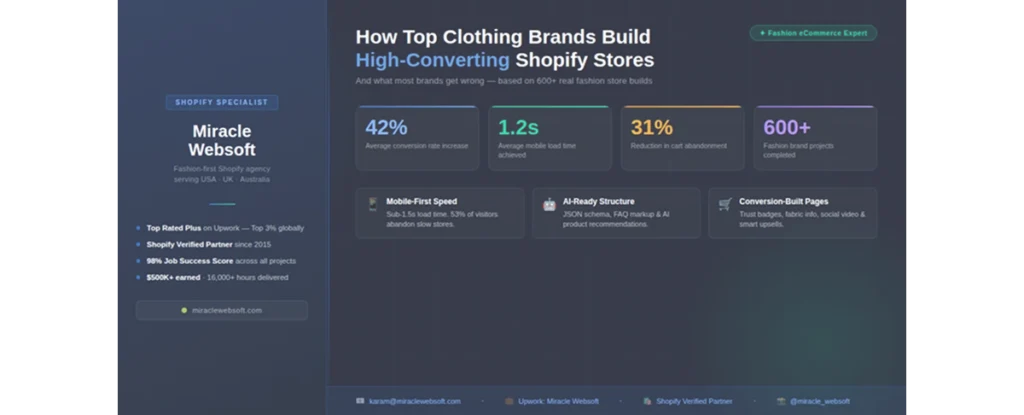
Karam is a Shopify Certified Developer and founder of Miracle Websoft, who has spent over a decade building high-converting Shopify stores for fashion brands across the USA, UK, and Australia. After working on 600+ Shopify projects and helping brands achieve an average 42% increase in conversions, he has identified a clear playbook for what separates a store that sells from one that doesn’t.
Here is what he has learned.
The Mobile Problem Nobody Talks About Honestly
Open your own store on your phone right now. Count how many seconds it takes to load.
If it crosses three seconds, you have already lost more than half your potential customers. Research shows 53% of visitors abandon a site that takes longer than 3 seconds on mobile — and fashion shoppers are among the least patient of any eCommerce category.
Miracle Websoft’s benchmark for every store they build: sub-1.5 seconds on mobile. One luxury fashion client came to them with a beautiful store and a painfully slow one. After a full speed overhaul — image compression, JavaScript reduction, critical CSS inlining — the store hit 1.1 seconds on mobile. Sales followed.
But speed is only half the mobile story. Buttons that are too small to tap. Product images that don’t zoom properly. Size guides hidden three scrolls down. These are not minor issues — they are the reason customers leave and never come back.
The Product Page Is Where Money Is Made or Lost
Most clothing brands spend their entire budget on ads to drive traffic, then lose that traffic on a product page that doesn’t do its job. A product page for a fashion brand needs to answer every question a customer has before they feel the need to ask it — because online shoppers don’t ask questions. They leave.
The highest-converting product pages Karam’s team builds share a common structure:
Show key features before the Add to Cart button. ‘Breathable Cotton,’ ‘True to Size,’ ‘Ethically Made’ — these aren’t just selling points. They’re objection-crushers placed exactly where the buying decision is made.
Fabric and material information, in full. Composition, weight, texture, care instructions. Customers who can’t feel a fabric through a screen need to read it instead. Detailed fabric information also directly reduces returns — one of the biggest margin killers for clothing brands.
Instagram and social video on the product page. A static image shows what a garment looks like. A real person wearing it in a video shows how it moves, how it fits, and how it actually looks in daylight. Embedding Instagram reels or brand videos on the product page turns social proof into a conversion tool at the exact moment it matters most.
Trust badges near the buy button. Secure checkout. Free returns. Size guarantee. Money-back assurance. These signals are especially important for first-time visitors who need a reason to trust a brand they have never bought from before.
The AI Revolution Most Clothing Brands Are Ignoring
Here is something most Shopify developers won’t tell you yet: the way customers discover products is changing fast. Shoppers increasingly use AI tools — ChatGPT, Google’s AI Overviews, Perplexity — to search for and shortlist products before visiting any store. If your store isn’t structured for AI, you are invisible to a growing segment of buyers.
JSON Schema and Structured Data. Proper schema markup tells AI crawlers and search engines exactly what your products are, what they cost, their availability, and their reviews. Stores with correct schema appear in AI-generated recommendations. Stores without it don’t.
AI-Friendly FAQ sections. A structured FAQ on every product page — marked up correctly — helps AI tools surface your products as direct answers to shopper questions.
AI-Powered Product Recommendations. For stores with large catalogues, AI-driven recommendation engines show each visitor the products most relevant to them — increasing average order value without requiring any manual work.
Upselling and Cross-Selling Done Right
Growing revenue doesn’t always mean finding new customers. Often it means better serving the ones already in your store.
A shopper adding a dress to their cart should see a natural suggestion for a matching belt or earrings. A customer viewing a basic tee should see the premium version at a small price difference. When implemented thoughtfully, these moments feel like helpful recommendations — not pushy sales tactics.
Miracle Websoft’s case studies show a consistent pattern: brands that implement strategic upsell and cross-sell flows alongside improved product pages see cart abandonment fall by an average of 31% and repeat purchase rates improve meaningfully.
What a Store Built to Sell Actually Looks Like
The difference between a store that looks good and a store that performs comes down to decisions made during development — decisions most brands never see.
A women’s boutique that worked with Miracle Websoft cut cart abandonment by 35% after a checkout flow rebuild and Klaviyo integration. An activewear brand increased conversions by 48% after TikTok Shop integration and a mobile product page rebuild. A streetwear brand migrated from WooCommerce to Shopify with zero SEO traffic loss across 4,000 products and 15,000 customer records.
These results don’t happen by accident. They happen because every decision — from button placement to page structure to backend code — was made with the customer’s buying journey in mind.
The Bottom Line for Clothing Brand Owners
If your store is getting traffic but not converting, the product is rarely the problem. The store is.
Fashion has the highest cart abandonment rate of any eCommerce category. 77% of shoppers leave before buying. Most of that is fixable — not with more ads, but with better development.
The brands winning in fashion eCommerce today aren’t necessarily the ones with the biggest budgets. They’re the ones who understood that every detail of their Shopify store — speed, structure, product page content, AI readiness — was built with one purpose: to convert visitors into buyers.
About Miracle Websoft
Miracle Websoft is a Shopify-specialist agency founded by Karam Singh, building high-converting stores exclusively for fashion and clothing brands across the USA, UK, and Australia.
Website miraclewebsoft.com
Shopify Partner shopify.com/partners/directory/partner/miracle-websoft1
Upwork (Karam) upwork.com/freelancers/~0108a0862ff3e2f2de
Upwork (Agency) upwork.com/ag/shopifyexpertsdevelopers/
LinkedIn linkedin.com/in/ecommerce-experts/
Instagram instagram.com/miracle_websoft/
Facebook facebook.com/miraclewebsoft/
Email karam@miraclewebsoft.com
WhatsApp +91 6239 269736
Get a free Shopify store audit → miraclewebsoft.com/contact